
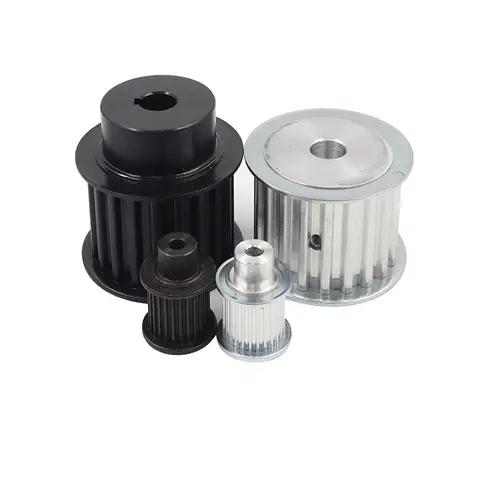
Industrial Aluminium T10 Timing Belt Pulley for Lowes Air Compressor
Our T10 timing belt pulleys have been designed using high-quality aluminum material for optimal performance in industrial applications. With a certificate of ISO9001, our T10 timing belt pulleys come in a wide range of teeth profiles including 5M, 8M, MXL, XL, L, H, 2M, S2M, 3M, S3M, 5M, 8M, 14M, T2.5, and T5. Our product is customizable to fit specific requirements, with bore widths ranging from 4-50mm and an inner bore of 2-200mm (H7 precision), including bore types such as taper hole, pilot bore, and round hole.
Product Specifications
| Type | Timing Belt Pulley |
| Certificate | ISO9001 |
| Teeth Profile | 5M 8M MXL XL L H 2M S2M 3M S3M 5M 8M 14M T2.5 T5 |
| Belt Width | 4-50mm |
| Inner Bore | 2-200mm H7 precision or customized |
| Bore type | Taper hole, pilot bore, round hole |
| Color | OEM |
| Surface treatment | Anodize, Black Oxide, Phosphate and Galvanization |
Our T10 timing belt pulleys are available in a variety of surface treatments, such as anodize, black oxide, phosphate, and galvanization, for additional protection against wear and tear.
FAQs
-
Can I get a sample of the T10 timing belt pulley?
Yes, we welcome sample orders to test and check the quality of our T10 timing belt pulleys. Mixed samples are also acceptable.
-
What is the lead time for T10 timing belt pulley orders?
The lead time for a sample order is typically 2-3 days. Mass production orders usually take 20-30 days. If you have an urgent order, we have a green channel to expedite production.
-
What is the minimum order quantity for T10 timing belt pulleys?
We have a low minimum order quantity of 1 piece for sample checking.
-
Can I have my company’s logo printed on the T10 timing belt pulleys?
Yes, we can print your logo or design before mass production. Please inform us of your logo or design requirements when placing your order.
-
How can I be sure of the quality of your T10 timing belt pulleys?
Our T10 timing belt pulleys are highly regarded and have been accepted by one of the top suppliers of international famous Belt company over the years. We are dedicated to providing excellent quality products along with considerate services. Please contact us for more details.
At our company, we offer a wide range of industrial products, including agricultural gearboxes, shafts, sprockets, fluid couplings, worm gear reducers, gears and racks, double pitch roller chains, timing pulleys and pulleys, planetary gearboxes, timing pulleys, bushings, and more. We pride ourselves on providing high-quality products at affordable prices, along with exceptional customer service. We welcome custom drawing and sample orders to meet specific requirements. Contact us today to learn more!
Disclaimer: All the content on this page is from the Internet and is only provided for reference purposes for product selection. Our products are replacement parts and not original spare parts. We are not the holder of the original trademarks mentioned in the content. Our replacement parts are designed to perfectly adapt to the original spare parts. If you need to purchase original spare parts, please contact the original manufacturer or supplier.
Introduction
Timing pulleys are essential components in power transmission systems. They are used to transmit torque from a driving shaft to a driven shaft, resulting in motion or power transfer. These pulleys are commonly used in various industries, including robotics, automotive, 3D printing, CNC machines, and conveyor systems. Timing pulleys are designed to provide accurate and consistent motion and power transfer, making them an essential component in many applications. In this article, we will explore the performance characteristics, types, advantages, applications, and future development trends of timing pulleys.
Performance Characteristics
Timing pulleys have several performance characteristics that make them ideal for power transmission systems. Firstly, the tooth profile of the pulley provides accurate positioning and consistent motion. Secondly, timing pulleys have a higher torque capacity compared to other pulley types. Thirdly, they offer low backlash, ensuring consistent power transfer. Fourthly, the pulleys are self-aligning, reducing wear and improving efficiency. Lastly, timing pulleys are low maintenance, making them a cost-effective solution for many industries.
Types and Characteristics
Timing pulleys are categorized based on their tooth profile, pitch, and material. The most common tooth profiles are MXL, XL, L, H, and XH. The pitch of the pulley refers to the distance between the tooth centers, and it can be metric or imperial. Timing pulleys can be made of various materials, including aluminum, steel, and plastic. The material used determines the pulley’s strength, durability, and load capacity. Aluminum pulleys are lightweight and have high-speed capabilities, while steel pulleys have high load capacities and are suitable for heavy-duty applications. Plastic pulleys are used in applications where low noise and corrosion resistance are required.
Advantages of Timing Pulleys Made of Different Materials
Timing pulleys made of different materials have their advantages. Aluminum pulleys are lightweight, have high-speed capabilities, and are suitable for high-speed applications. They are also corrosion-resistant and have excellent heat dissipation properties. Steel pulleys have high load capacities, making them suitable for heavy-duty applications. They are also wear-resistant, durable, and have a long lifespan. Plastic pulleys are lightweight, have low noise, and are corrosion-resistant. They are also self-lubricating, reducing the need for maintenance.
Applications
Timing pulleys have a wide range of applications in various industries. In the robotics industry, timing pulleys are used to control the motion of robotic arms and grippers. In the automotive industry, they are used to control the timing of the engine valves, resulting in efficient engine operation. In 3D printers, timing pulleys are used to control the movement of the print head and the print bed. In CNC machines, timing pulleys are used to control the movement of the cutting tool and the workpiece. In conveyor systems, timing pulleys are used to control the motion of the conveyor belt, resulting in efficient product transportation.
Future Development Trends and Opportunities
The timing pulley market is expected to grow in the coming years due to the increasing demand for automation and robotics in various industries. The development of new materials and manufacturing techniques is expected to improve the performance and efficiency of timing pulleys. The increasing use of 3D printing technology is also expected to drive the growth of the timing pulley market.
How to Choose a Suitable Timing Pulley
Choosing a suitable timing pulley requires considering several factors. Firstly, the load capacity of the pulley should be able to handle the required load. Secondly, the material of the pulley should be suitable for the application and environment. Thirdly, the diameter and size of the pulley should be appropriate for the application. Fourthly, the type of pulley should be chosen based on the application requirements. Lastly, the bore size of the pulley should be compatible with the shaft size of the driving and driven shafts.
Summary
Timing pulleys are essential components in power transmission systems, providing accurate and consistent motion and power transfer. They have various performance characteristics that make them ideal for many applications. Timing pulleys can be categorized based on their tooth profile, pitch, and material, each with its advantages. They have a wide range of applications in various industries, and their future development looks promising. When choosing a suitable timing pulley, several factors should be considered, including load capacity, material, diameter and size, type of pulley, and bore size.